 Health and Safety Policy for Office Clearance Notting Hill
This policy sets out a clear and practical approach to health and safety for all employees, contractors and partners engaged in office clearance and commercial rubbish removal activities. The aim is to maintain a safe working environment during any workplace clearance, disposal or recycling operation while protecting people, property and the environment. The document applies to every stage of a clearance project from site preparation, removal of bulky items and sensitive materials, to transport and disposal. It recognises the distinct risks that occur in office clearance, workplace removal and associated waste handling services.
 Our commitment is to ensure that all tasks are planned and executed with safety as the primary consideration. We will apply proportionate risk management for each job, including a pre-clearance survey, task-specific risk assessments and permit-to-work where necessary. The policy promotes safe systems of work and requires all personnel to follow agreed procedures when undertaking domestic, office or commercial clearance operations, including manual handling and operating clearance vehicles.
Roles, Responsibilities and Training
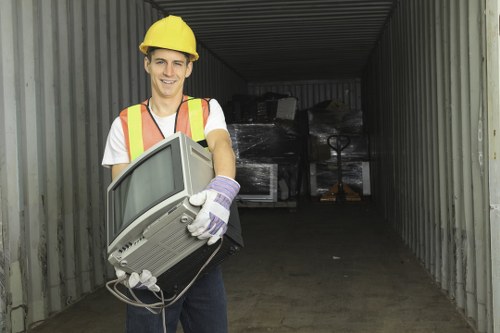 Effective safety management relies on clearly assigned responsibilities. Management will provide leadership and resources, ensuring that every clearance crew member receives appropriate training, supervision and personal protective equipment. Site supervisors are responsible for implementing safe methods, conducting toolbox talks and ensuring that all staff understand emergency arrangements. Every operative must report hazards and follow control measures; failure to do so will be addressed through performance and disciplinary procedures.
Training focuses on safe lifting techniques, safe use of trolleys and sack trucks, correct waste segregation and handling of hazardous items which may be encountered during a clearance job. Instruction will include vehicle loading safety, fall prevention when working on stairs or mezzanines, and the safe disposal of e-waste and office fixtures. Use of PPE such as gloves, eye protection and high-visibility clothing is mandatory where the risk assessment requires it.
- Risk assessments completed before work starts to identify hazards and set control measures.
- Safe systems of work documented for repetitive tasks like lifting, dismantling furniture and loading vans.
- Vehicle and plant checks to ensure transport used for rubbish collection is roadworthy and load-secure.
- Clear waste segregation to maximise recycling and reduce environmental harm.
- First aid facilities and trained personnel available on larger clearances.
Operational Controls, Monitoring and Review
 This organisation will maintain monitoring systems to ensure compliance with safety standards during office clearance and rubbish removal operations. Regular site inspections, near-miss reporting and incident reviews form part of the continuous improvement cycle. When incidents occur, they will be investigated promptly to identify root causes and to revise procedures as necessary. Audits of work practices and training records will be undertaken to verify that control measures remain effective.
 Emergency arrangements form an essential part of the safety plan. Crews will be briefed on evacuation routes, assembly points and how to summon help if a serious injury or fire occurs. Vehicle incidents and road safety considerations are treated seriously; drivers and loaders are required to follow driving time guidance, secure loads correctly and comply with safe reversing procedures.
Environmental protection and waste handling are integral to this health and safety policy. All staff must ensure safe separation of recyclable materials from general waste and follow procedures for controlled disposal of potentially hazardous items such as batteries, fluorescent tubes, toner cartridges and electronic equipment. The company promotes waste reduction and reuse where possible and supports sustainable clearance practices.
Communication plays a central role in delivering safety outcomes. Pre-job briefings, structured handovers and documented instructions help ensure that everyone understands their tasks and the associated hazards. Supervisors will maintain clear records of training and toolbox talks to demonstrate ongoing competency in office clearance and rubbish removal operations.
Health and wellbeing of personnel is also a priority. The policy supports measures to manage manual handling strain, fatigue and stress that can arise from intensive clearance schedules. Where necessary, work tasks will be rotated, mechanical aids provided and staffing levels adjusted to reduce physical risk.
Contractors and sub-contractors engaged in clearance tasks must comply with the same standards and are required to evidence their competence before commencing work. Sub-contract arrangements include defined responsibilities for site safety, coordination of vehicle movements and control of visitors to clearance sites.
This policy will be reviewed periodically and updated when operational changes, new hazards or industry best practice indicate a need for amendment. The organisation expects continuous improvement and will support initiatives that enhance safety performance, reduce waste-related risk and promote responsible clearance practices across all office and commercial projects.
